Revision Knee Replacement & Failed Implant Surgery, Ahmedabad

Revision Knee Replacement Surgery in Ahmedabad — When Your First Surgery Has Failed

A failed, painful or worn knee implant needs specialist revision, not repeated conservative management. A revision knee replacement surgeon focuses on identifying the exact cause of failure and planning the right corrective procedure. Revision knee replacement is a complex and technically demanding surgery that requires the experience and implant systems needed to manage what a primary replacement could not resolve.

7+
Years Revision Exp
100%
Satisfaction Rate
Complex
Implant Systems
Second
Opinion Welcome
Insurance Accepted
Revision Specialists
Second Opinions Welcome

Book A Consultation

Our specialist will call you within 2 hours
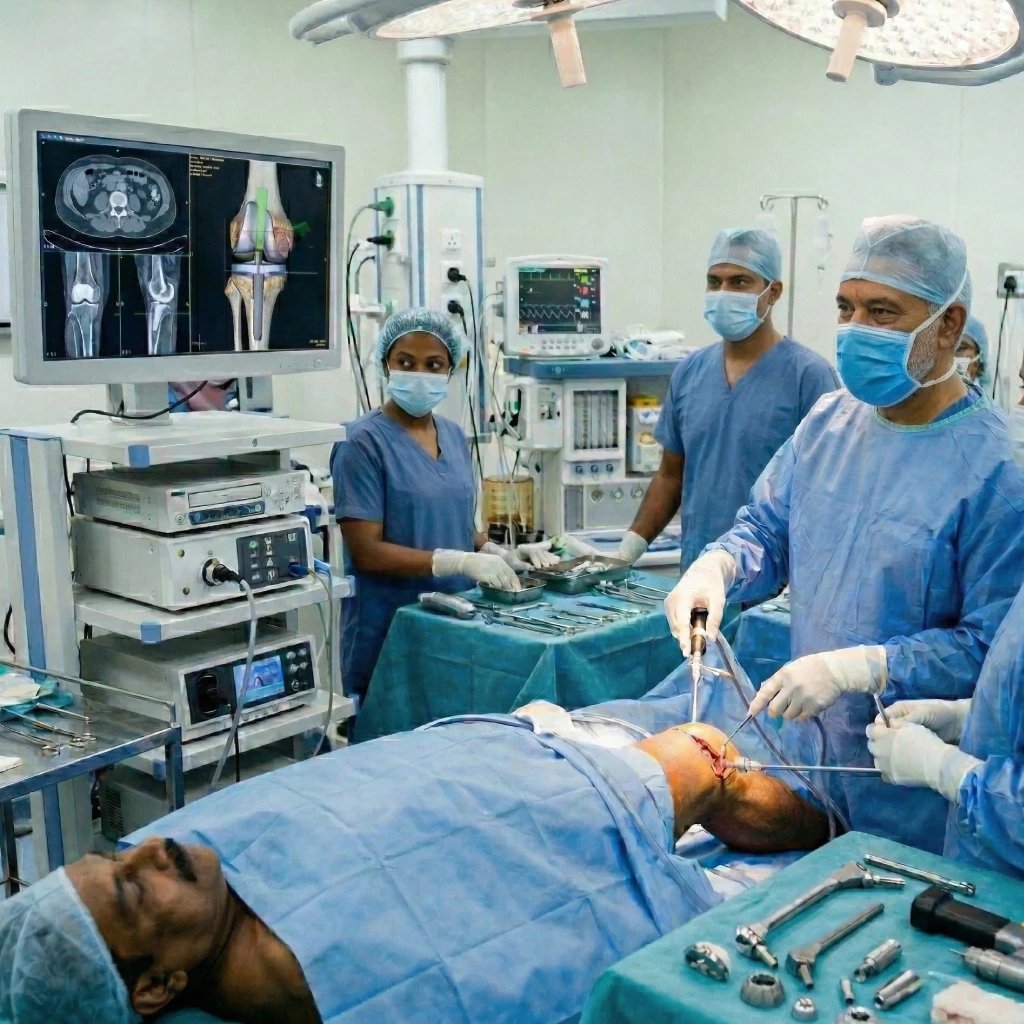
    Revision Knee Replacement
    What is Revision Knee Replacement?

    What is Revision Knee Replacement Surgery? (Failed Implant Explained)

    Revision knee replacement is a surgical procedure to remove and replace a failed, worn, loose or infected knee implant. This form of knee revision surgery in Ahmedabad is more complex than a primary knee replacement, as the surgeon must work around scar tissue from the previous operation, manage bone loss and use specialised implant systems designed for revision cases. Not every orthopaedic surgeon has the case volume, specific training or implant inventory to perform revision knee surgery safely. It requires a centre with dedicated expertise.

    The causes of knee replacement failure vary. Aseptic loosening, where the implant becomes loose without infection, is the most common. Other causes include infection, instability, stiffness, implant wear and fractures around the implant. A revision knee replacement surgeon carefully evaluates each of these factors before deciding the correct surgical plan. Each cause requires a different approach to revision surgery. The pre-operative assessment, including X-rays, CT scan, blood markers for infection and joint aspiration, is as important as the surgery itself. At Trayam Hospital, every revision case is assessed by our joint replacement team with a full investigation protocol before surgical planning begins.

    • Removes and replaces failed, loose, infected or worn knee implants — restoring function and eliminating pain
    • Specialised revision implant systems — handle bone loss and instability that primary implants cannot address
    • Thorough pre-operative assessment — infection markers, CT for bone loss, joint aspiration — before any revision surgery
    • Two-stage revision for infected implants — ensures complete infection eradication before re-implantation
    • Complex reconstruction expertise — bone grafting, augments and stems where significant bone loss is present
    Do You Need It?

    Signs Your Knee Replacement Has Failed — When to See a Revision Specialist in Ahmedabad

    If you have had a previous knee replacement and are experiencing these symptoms, specialist review is recommended
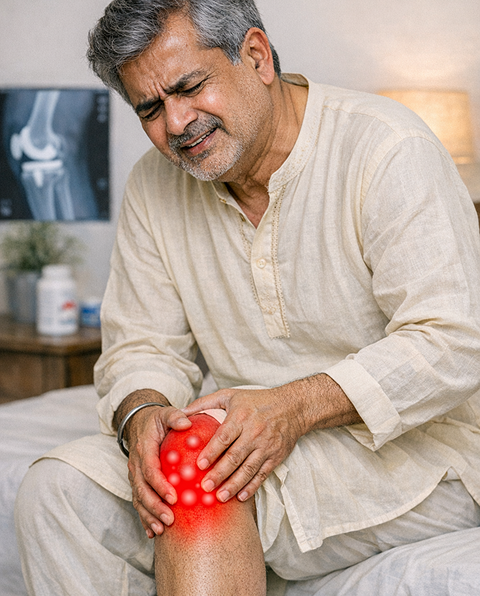
    Persistent Knee Pain After Replacement — Possible Implant Failure

    Persistent Knee Pain After Replacement — Possible Implant Failure

    Pain that never fully resolved after knee replacement, or pain that was well-controlled and has returned months or years after surgery — the most common symptom of implant failure. Pain with any knee replacement that has not improved by 3–6 months post-operation warrants specialist review.
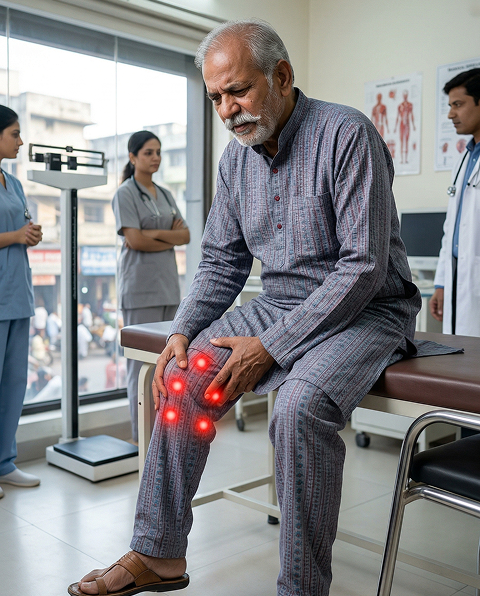
    Loose or Unstable Knee After Replacement — Implant Loosening Signs

    Loose or Unstable Knee After Replacement — Implant Loosening Signs

    A sense of the knee giving way, wobbling or lacking the stability you had after initial recovery — indicates ligament imbalance, implant loosening or tibial component subsidence. Instability after knee replacement is one of the leading indications for revision surgery.
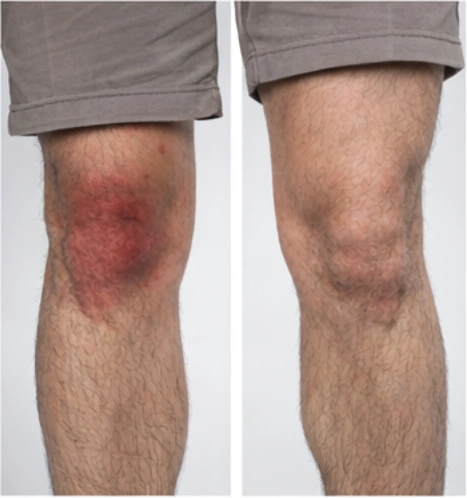
    Swelling, Redness & Warmth — Possible Infected Knee Replacement

    Swelling, Redness & Warmth — Possible Infected Knee Replacement

    Persistent or recurrent swelling, heat and redness around a knee replacement — especially with fever or raised inflammatory markers — strongly suggests periprosthetic joint infection (PJI). Infected knee replacements require urgent specialist assessment. This is a surgical emergency if fever and systemic illness are present.

    Severe Knee Stiffness After Replacement — Arthrofibrosis Symptoms

    Severe Knee Stiffness After Replacement — Arthrofibrosis Symptoms

    Inability to bend the knee beyond 90 degrees or fully straighten it after knee replacement — despite physiotherapy. Arthrofibrosis (excessive scar tissue formation) is a recognised complication of knee replacement that may require arthroscopic release or revision surgery in severe cases.
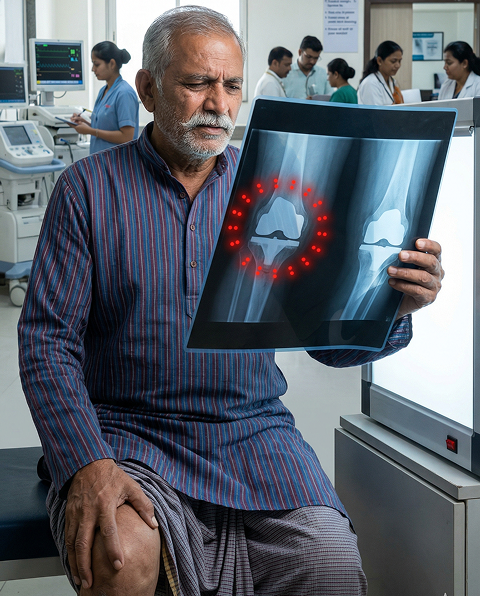
    X-Ray Shows Shifted Implant — Aseptic Loosening Diagnosis

    X-Ray Shows Shifted Implant — Aseptic Loosening Diagnosis

    Your follow-up X-ray shows the implant has changed position, subsided into the bone or developed a radiolucent line around the cement — indicating aseptic loosening. Even in the absence of severe pain, implant loosening is a clear indication for revision before bone loss progresses further.
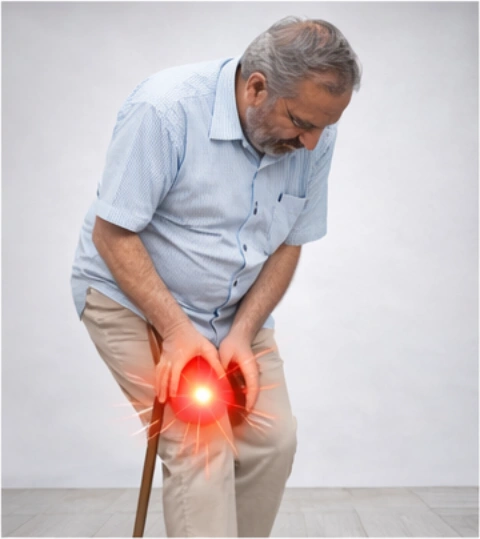
    Knee Implant Over 10 Years Old — When to Consider Revision Surgery

    Knee Implant Over 10 Years Old — When to Consider Revision Surgery

    Knee implants have a typical lifespan of 15–20 years. Increasing pain, new stiffness or functional decline in a patient with an implant that is 10 years or older warrants assessment for wear-related revision — before catastrophic implant failure occurs.
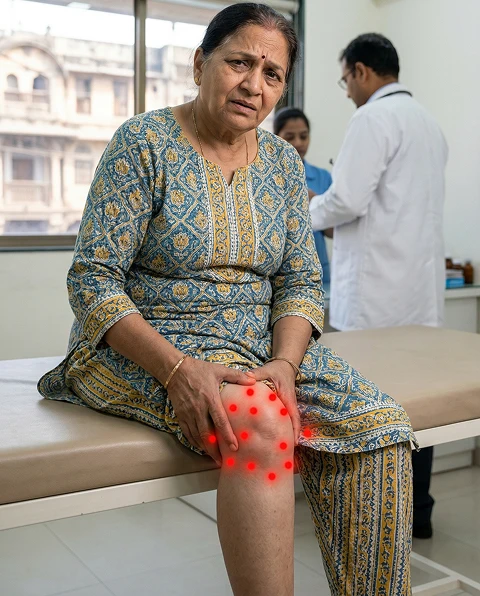
    Periprosthetic Fracture — Bone Fracture Around Knee Implant

    Periprosthetic Fracture — Bone Fracture Around Knee Implant

    A periprosthetic fracture — a fracture of the bone immediately around the knee implant — from a fall or trauma. Requires urgent orthopaedic assessment and in many cases revision surgery to address both the fracture and implant stability simultaneously.

    Knee Implant Allergy or Metal Sensitivity Reaction

    Knee Implant Allergy or Metal Sensitivity Reaction

    A small number of patients develop hypersensitivity reactions to implant materials — particularly nickel, cobalt or chromium alloys. Symptoms include persistent pain, swelling and skin changes without evidence of infection or loosening. Assessment includes metal sensitivity testing and, where confirmed, revision to an alternative implant material.

    Why Trayam

    Why Choose Trayam for Revision Knee Replacement Surgery in Ahmedabad?

    Revision knee replacement requires a higher level of surgical expertise, detailed planning and access to specialised implant systems. Choosing the right centre for knee revision surgery is essential for achieving a safe and long-lasting outcome.

    500+
    Revision Procedures
    100%
    Patient Satisfaction
    7+
    Years Experience
    Full
    Implant Inventory

    Full Pre-Revision Assessment — CT, Infection Markers & Joint Aspiration

    Every revision patient at Trayam receives a full investigation protocol before surgical planning: standing X-rays, CT scan for bone loss mapping, ESR/CRP/D-dimer infection screening, and joint aspiration where infection is suspected. The correct diagnosis of failure mode determines the correct revision strategy.

    Complete Revision Implant Inventory — Stems, Augments & Constrained Implants

    Revision knee replacement requires access to specialised implant systems — stems, augments, tibial sleeves and constrained implants — that are not part of a standard primary replacement inventory. Trayam carries a comprehensive revision implant inventory, allowing the surgeon to manage any degree of bone loss or instability intraoperatively.

    Two-Stage Revision Protocol for Infected Knee Replacement

    Periprosthetic joint infection requires a two-stage approach for the highest eradication rates: stage 1 removes the implant and infected tissue, with an antibiotic cement spacer placed; stage 2 re-implants a new prosthesis after 6–8 weeks of IV antibiotics and confirmed infection clearance. This protocol achieves infection eradication in over 85% of cases.

    Bone Loss Reconstruction — Grafting, Augments & Tibial Stems

    Failed implants cause progressive bone loss that must be managed at the time of revision. Our surgeons are trained in bone grafting techniques — impaction grafting, structural allograft, and the use of metal augments and tibial stems — to reconstruct the joint to a stable, durable platform for the revision implant.

    Dedicated Revision Knee Replacement Surgeon in Ahmedabad

    Revision knee replacement is a subspecialty within orthopaedics. The surgical complexity, complication profile and learning curve are significantly higher than primary replacement. Our revision surgeons have specific fellowship training and case volumes in revision joint replacement — experience that directly determines outcome.

    Free Second Opinion on Revision Knee Replacement in Ahmedabad

    If you have been told your knee replacement has failed and revision surgery is recommended — or if you are uncertain about a revision recommendation you have received — our team welcomes second opinion consultations. We will review your X-rays, investigations and history and give you an independent, honest assessment.

    Expert Care

    Meet Dr. Parth Patel — Revision Knee Replacement Surgeon in Ahmedabad

    Dr. Parth Patel
    MS Orthopaedics Revision Joint Replacement Complex Reconstruction 7+ Yrs Exp

    Dr. Parth Patel

    Senior Consultant — Joint Replacement & Revision Orthopaedic Surgery, Trayam Hospital

    Dr. Parth Patel has performed over 500 revision knee replacement procedures — from straightforward single-component revisions to complex two-stage infected implant revisions with significant bone loss reconstruction. Revision surgery demands a surgeon who has seen the full spectrum of implant failure modes, has access to the right implant systems and approaches each case with a detailed pre-operative plan rather than improvising intraoperatively. Every revision patient at Trayam receives a personal consultation with a full review of their imaging and investigations before any surgical decision is made.

    • MS Orthopaedics
    • Fellowship in Joint Replacement & Revision Surgery
    • International Training — Revision Arthroplasty, Germany & USA
    • Published research in revision knee replacement outcomes and PJI management
    • Speaker — Indian Society of Hip & Knee Surgeons (ISHKS) Conferences
    Procedures We Offer

    Types of Revision Knee Replacement Surgery We Perform in Ahmedabad

    The revision approach is determined by the cause of failure, and each case requires a different surgical strategy. Knee revision surgery involves careful planning based on implant condition, bone quality and the presence of infection or instability.

    Aseptic Revision Surgery — Loose or Worn Knee Implant

    The implant has loosened or worn without infection — the most common cause of late knee replacement failure. Revision involves removing the loose components, preparing the bone surfaces, managing any bone loss with augments or grafts, and implanting revision components. Single-stage procedure. Success rate over 90% at 10 years in correctly selected cases.

    Most Common

    Two-Stage Revision for Infected Knee Replacement (Periprosthetic Joint Infection)

    Periprosthetic joint infection (PJI) requires a two-stage revision: Stage 1 — implant removal, radical debridement of infected tissue, antibiotic cement spacer placement. 6–8 weeks of targeted IV antibiotics. Stage 2 — re-implantation once blood markers confirm infection clearance. Two-stage revision achieves infection eradication in over 85% of cases. The most complex revision scenario.

    Two-Stage

    Revision for Knee Stiffness After Replacement — Arthrofibrosis Treatment

    Severe post-replacement stiffness (flexion under 90 degrees) that has not responded to physiotherapy. Initial treatment: arthroscopic release or manipulation under anaesthesia (MUA). When these fail or fibrosis is severe, open revision surgery to release contracted structures and exchange the components may be required. Early treatment gives the best outcomes — do not accept a stiff knee as inevitable.

    Stiffness

    Complex Revision Surgery — Knee Instability, Fracture & Bone Loss Reconstruction

    Instability after knee replacement (ligament imbalance or component malposition), periprosthetic fracture and severe bone loss from long-standing implant failure — requiring the most complex revision strategies. Constrained implants, tibial stems, metal augments and bone grafting may all be required. These cases require a centre with the full implant inventory and surgeon experience to manage what is found intraoperatively.

    Complex
    What to Expect

    Revision Knee Replacement Recovery — What to Expect Week by Week

    A step-by-step guide to your recovery after Total Knee Replacement at Trayam Hospital.

    Day 1–2

    Surgery completed. Physiotherapy begins — first assisted standing and walking with a walking frame. Close monitoring of wound, blood count and inflammatory markers. Pain managed with multimodal analgesia.

    Day 3–7

    Hospital discharge for straightforward aseptic revisions. Two-stage septic revision patients remain for IV antibiotics — discharged when oral transition is confirmed. Walking with walker. Wound check at day 5–7.

    Week 2–3

    Wound review and suture removal. Home physiotherapy programme established. Swelling gradually reducing. Walking aids progressively reduced as strength returns.

    Week 6

    Outpatient review with X-ray confirming implant position. Most patients walking with a stick or unaided. Range of motion progressing. Driving discussed based on which leg and rate of recovery.

    Month 3

    Significant improvement in pain and function compared to pre-revision. Most daily activities resumed. Physiotherapy continuing — strength and stability focus.

    Month 6–12

    Full functional recovery for most patients. Return to light recreational activity. Long-term annual follow-up with X-ray to monitor implant stability — essential for revision patients throughout life.


    Patient Stories

    Patient Reviews — Revision Knee Replacement at Trayam Hospital, Ahmedabad

    Trayam Hospital place picture
    5.0
    Based on 27 reviews
    powered by Google
    Jatin Patel profile picture
    Jatin Patel
    13:41 17 Apr 26


    I had severe back pain for years and was scared of surgery. Dr. Parth Patel at Trayam Hospital explained everything very calmly. My spine surgery went smoothly, recovery was fast, and I can walk pain-free now. Thank you sir for giving me my normal life back.
    Hitesh Vaghela profile picture
    Hitesh Vaghela
    05:18 10 Mar 26
    I have severe neck pain and difficulty in walking and imbalance with radicular pain
    Dr parth have operated cervical spine and I m very thankful to him.best spine surgeon
    Sudha Patel profile picture
    Sudha Patel
    14:16 02 Feb 26
    Really good service & good support.
    MUKESH PATEL profile picture
    MUKESH PATEL
    14:11 02 Feb 26
    Best orthopeadic and urology hospital
    Staff is polite and doctor provide best result.
    Umang Patel profile picture
    Umang Patel
    13:29 07 Jan 26
    Very nice hospital and surgery successfully completed also Dr. And staff very helpful.
    Ketan Darji profile picture
    Ketan Darji
    08:11 13 Dec 25
    I underwent total knee replacement at Trayam Hospital. From pre-surgery counselling to physiotherapy, everything was handled with full attention. Dr. Parth Patel’s team is excellent. I can walk comfortably now after many years.
    Raju Bhai profile picture
    Raju Bhai
    06:51 13 Dec 25
    I had slipped disc problem and was afraid of operation. Dr. Parth Patel did endoscopic spine surgery and it was a life changer. The hospital rooms are clean and staff is always smiling. Thank you Trayam Hospital!
    Sagar Kumar profile picture
    Sagar Kumar
    05:30 13 Dec 25
    Trayam Hospital is truly patient-friendly. Both Dr. Parth Patel and Dr. Renish Patel are very humble and professional. Staff is polite, rooms are neat, and treatment quality is top-notch. Best orthopaedic and urology hospital in Ahmedabad. 🙏
    Aastha Patel profile picture
    Aastha Patel
    06:53 16 Nov 25
    Trauma hospital exceeded my expectations! Dr. Parth's care and diagnosis really helped ease my foot pain, which I had been dealing with for a while. Appreciate the spot-on treatment and the team's support. Would definitely recommend
    A Common Problem in India

    Tired of Being Quoted Told Your Painful Knee Replacement Is "Normal" — And Given Another Injection? at Every Hospital?

    The most consistently under-investigated problem in joint replacement in India is the patient with a painful knee replacement who is repeatedly reassured that their X-ray looks fine. Pain after knee replacement is not always visible on a plain X-ray — loosening may only appear on CT, infection is diagnosed on blood markers and joint aspiration, and instability may only be apparent under clinical stress testing. If your replaced knee is still causing significant pain after 6 months and you are being managed with injections and physiotherapy without a systematic investigation into why, you deserve a specialist second opinion.

    • Pain after knee replacement managed with injections for months without investigation into the cause — a knee replacement that has failed needs to be investigated, not repeatedly injected. Pain that persists beyond 6 months post-replacement, pain that has recurred after a period of being well, or new pain in a previously comfortable replaced knee all warrant CT scan, infection markers and where appropriate, joint aspiration — not another steroid injection.
    • Told "revision is not possible" or "too complex to redo" — revision knee replacement is technically demanding and requires specific expertise, but it is almost always possible. A statement that revision cannot be done typically reflects the treating surgeon's experience limitations, not an inherent impossibility. Every patient with a failed knee replacement deserves assessment by a revision specialist.
    • Stiff knee accepted as "just how it is" after replacement — a knee that cannot bend adequately after replacement is not an inevitable outcome. Arthrofibrosis (excess scarring) is a treatable complication — manipulation under anaesthesia, arthroscopic release and in severe cases revision surgery can restore meaningful flexion. Do not accept a stiff knee without seeking specialist assessment.
    • Revision surgery quote that does not specify which components are being revised or what implant system will be used — revision surgery pricing varies significantly based on what components need to be replaced, whether bone grafting is required and which revision implant system is used. A revision quote should specify the planned procedure in detail — not a flat package price that may not cover what is found intraoperatively.
    The Trayam Promise What we quote is what you pay. No surprises. No fine print. No pressure.

    Complete Cost Breakdown — Before You Decide

    A fully itemised estimate covering surgery, implants (specified by system and component), stay, physiotherapy and follow-up — before you commit. Revision surgery pricing varies with complexity; we tell you exactly what is planned and why.

    Honest Assessment — Revision Only When Right

    We will tell you if your knee replacement pain can be managed without further surgery. We do not recommend revision surgery unless investigation confirms a clear, treatable cause of failure. An honest second opinion is always welcome — even if the answer is that revision is not yet needed.

    Insurance Guidance for Revision Cases

    Revision knee replacement is covered under most major health insurance policies. We manage the pre-authorisation process, ensuring that the complexity of revision surgery is correctly documented and claimed. No inflated billing — your coverage is respected.

    Speak to our team today. Get a clear second opinion on your surgery from a revision knee replacement surgeon.

    Confidential  ·  No Obligation  ·  Reply in 2 Hours

    Common Questions

    FAQs — Revision Knee Replacement Surgery Cost, Risks & Recovery in Ahmedabad

    Revision knee replacement is a procedure to remove and replace a failed, worn, loose or infected knee implant. It is significantly more complex than primary knee replacement and requires specialised implant systems, specific surgical training and thorough pre-operative investigation to determine the cause of failure before planning surgery.

    Signs include pain that never fully resolves or has returned after a period of being well, knee instability or a feeling of giving way, swelling and warmth that may indicate infection, or difficulty in bending the knee properly. In some cases, X-rays may show implant movement or radiolucent lines around the cement. If you notice any of these symptoms, it is important to consult a revision knee replacement surgeon in Ahmedabad for a detailed evaluation.

    Revision surgery typically takes 2–3 hours depending on complexity — longer than primary replacement because of scar tissue, bone loss management and the use of larger revision implant systems.

    Stage 1 removes the infected implant, debriding all infected tissue, and places an antibiotic cement spacer. 6–8 weeks of targeted antibiotics follows. Stage 2 re-implants a new prosthesis once blood markers confirm infection is fully cleared. Two-stage revision achieves infection eradication in over 85% of cases — the highest of any approach.

    Typically 5–7 days for aseptic revision. Septic revision patients stay longer for IV antibiotic management before transitioning to oral therapy. Two-stage revision: stage 1 approximately 7–10 days; stage 2 approximately 5–7 days.

    Recovery is longer than primary knee replacement. Most patients reach functional recovery by 3–6 months. Complex revisions with significant bone loss reconstruction may take 9–12 months for full recovery. Annual lifelong follow-up with X-ray is recommended for all revision patients.

    Yes — in some cases. Manipulation under anaesthesia (MUA) is performed at 6–12 weeks for early stiffness with good results. Arthroscopic scar tissue release is used for moderate fibrosis. Revision surgery is reserved for severe, long-standing stiffness that has failed these approaches. The earlier stiffness is treated, the better the outcome.

    Yes — revision knee replacement is covered by most major health insurance policies and PMJAY. The complexity of the procedure and implant requirements are documented in the pre-authorisation request. Our insurance desk manages this process in full.

    Failed Knee Replacement? You Deserve a Specialist Second Opinion — Not Another Injection

    Bring your X-rays, any existing reports and your surgical history. Our revision specialist will give you an independent, honest assessment of your options.

    Chat on WhatsApp